How to Scale a Recipe Up or Down (With a Quick Reference Table)
How to halve, double or resize any recipe without ruining it: what scales evenly, what does not, and how to handle pan sizes, eggs and cooking times.
Recipes are written for a set number of servings, and real life rarely matches. You want to cook for two, not six. Or you are feeding a crowd and need to triple the lot. Scaling a recipe sounds like simple multiplication, and mostly it is, but a few ingredients and steps do not scale in a straight line.
This guide covers the maths, the traps, and a quick reference table you can come back to.
Step 1: work out your scale factor
Divide the number of servings you want by the number the recipe makes.
- A recipe serves 4 and you want 6: 6 ÷ 4 = 1.5
- A recipe serves 8 and you want 2: 2 ÷ 8 = 0.25
- A recipe serves 4 and you want 8: 8 ÷ 4 = 2
Multiply every ingredient quantity by that number. Weights are the easy ones: 300 g of chicken at a factor of 1.5 is 450 g. Work in grams wherever you can, because it keeps the numbers clean.
Step 2: convert awkward measures
Cups and spoons are where scaling gets fiddly. These conversions use Australian measures (a cup is 250 ml, a tablespoon is 20 ml, a teaspoon is 5 ml). In the US a cup is about 240 ml and a tablespoon 15 ml, but the ratios below stay the same.
| Original | Halved | Doubled |
|---|---|---|
| 1 cup (250 ml) | 1/2 cup (125 ml) | 2 cups (500 ml) |
| 3/4 cup (180 ml) | 90 ml (about 4 1/2 tbsp) | 1 1/2 cups (375 ml) |
| 2/3 cup (170 ml) | 85 ml (about 4 tbsp) | 1 1/3 cups (335 ml) |
| 1/2 cup (125 ml) | 1/4 cup (60 ml) | 1 cup (250 ml) |
| 1/3 cup (80 ml) | 40 ml (2 tbsp) | 2/3 cup (170 ml) |
| 1/4 cup (60 ml) | 30 ml (1 1/2 tbsp) | 1/2 cup (125 ml) |
| 1 tbsp | 2 tsp | 2 tbsp |
| 1 tsp | 1/2 tsp | 2 tsp |
| 1/2 tsp | 1/4 tsp | 1 tsp |
| 1/4 tsp | a pinch | 1/2 tsp |
If you have a set of measuring spoons and a small jug marked in millilitres, the millilitre column is the most accurate.
Step 3: handle the ingredients that do not scale evenly
Salt, spices and strong flavours. When you double a recipe, double the main ingredients but start with about 1.5 times the salt, chilli and spices. Then taste and add more. Flavour does not always scale in a straight line, and you can always add but not take away.
Eggs. For odd numbers, beat an egg and measure it. One large egg is about 50 g (50 ml). Half an egg is 25 g.
Raising agents. Baking powder and bicarb soda scale fairly evenly for scales up to double. For large batches, or for a half recipe, measure carefully with proper spoons and level them off, because small errors show up.
Oil for frying and liquid in pots. When you scale up, you do not need double the liquid for braises and soups, because less evaporates from a larger pot. Start with about 75 to 80 percent of the scaled amount, then add more if it looks dry.
Yeast doughs. Scale the flour, water and salt as normal. Use a little less than the scaled yeast for big batches, and let the dough rise until it has doubled in size rather than by the clock.
Step 4: change the pan, not the time
For baking, the pan size matters more than the maths. Use the same depth of batter as the original recipe, which means matching the pan area. Here are some common pans by area:
| Pan | Approximate area |
|---|---|
| 20 cm round | 314 cm² |
| 23 cm round | 415 cm² |
| 25 cm round | 491 cm² |
| 20 cm square | 400 cm² |
| 23 cm square | 529 cm² |
| 20 x 30 cm slab | 600 cm² |
| 23 x 33 cm slab | 759 cm² |
Some handy equivalents: a recipe for a 20 cm square tin fits a 23 cm round tin, and a 23 cm square tin is about the same as a 26 cm round. To double a cake, bake two tins of the original size rather than one huge tin.
Step 5: cooking time and the oven
- Same pan, same depth: the time stays about the same.
- Deeper food: it takes longer, so start checking at the original time and then add a few minutes at a time.
- Two trays in one oven: swap them top to bottom halfway through, because the heat is uneven.
- Smaller portions: things cook faster. Check smaller cakes and meat early.
Always use a skewer, a thermometer or a visual cue to confirm the food is done, not just the clock.
When not to scale
Some recipes are better made twice than made once at double size. Examples include meringues and macarons, delicate cakes, fried foods that need space in the pan, and deep-fried batter. If in doubt, cook two batches.
Let an app do the maths
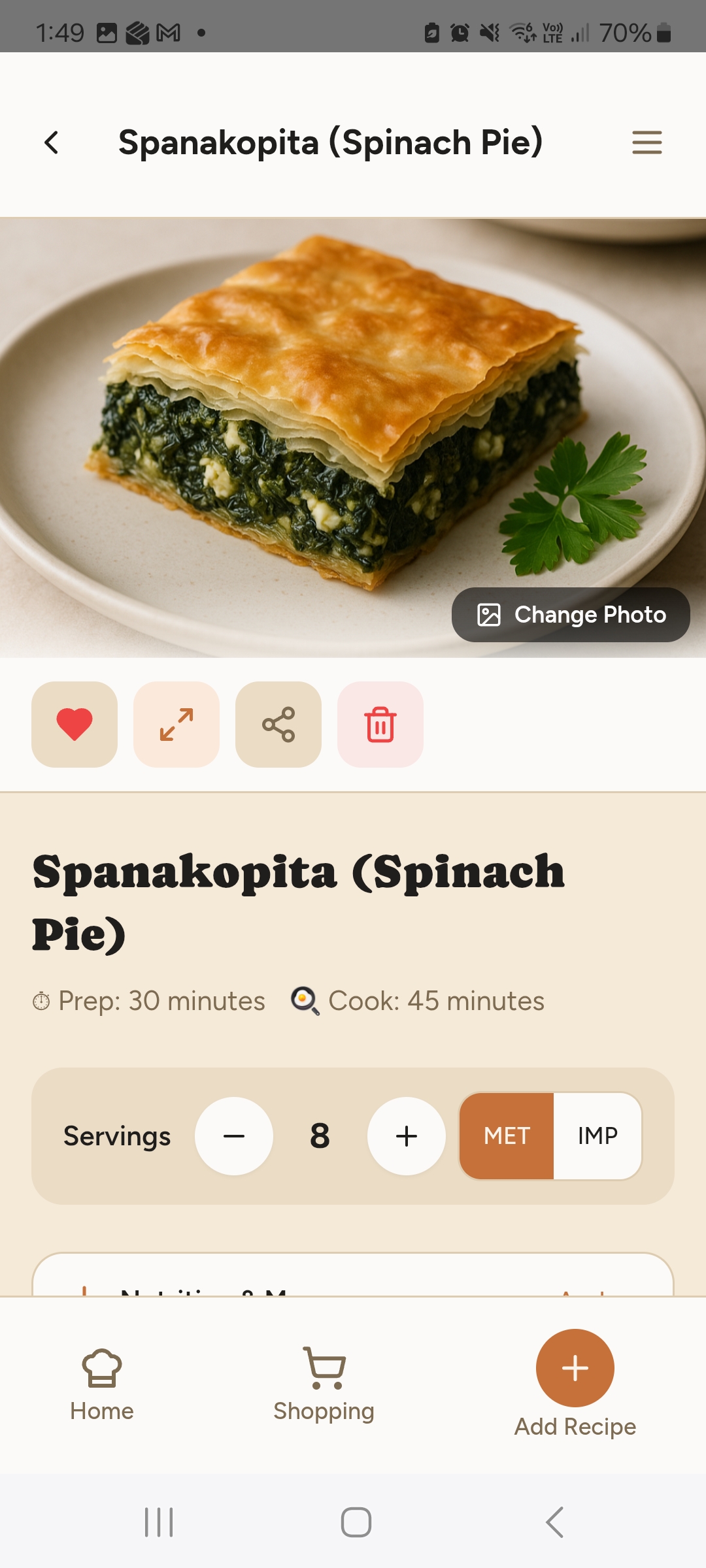
If you scale recipes often, a recipe app saves a lot of mental arithmetic. See also our cups to grams conversion table for turning cups into weights, which makes scaling easier still.
Common questions
How do I halve a recipe that uses one egg?
Beat the egg in a small bowl and use about half of it. One large egg is roughly 50 g, so you want about 25 g, or just under 2 tablespoons.
Do I double the cooking time when I double a recipe?
No. Cooking time depends on thickness and depth, not on how much you make. If you use two pans or trays, the time stays about the same. If you use one deeper pan, the time goes up a little. Start checking at the original time.
Can I double any recipe?
Most soups, stews, curries, sauces and bakes double well. Be careful with delicate bakes such as meringues, soufflés and some yeast doughs, and with frying, where crowding the pan stops food browning.
Why did my doubled cake not rise properly?
Usually the pan was too deep or too full, so the middle stayed raw while the edges set. Use two tins of the original size instead of one very large one.
Your recipes, pantry and macros in one place
- Import any recipe from a link or a photo of a cookbook page
- Browse a new themed Recipe Library every week
- Cook Mode shows one step at a time, with only the ingredients you need
- Check products for pesticides and seed oils before they reach your trolley
- Snap your plate to estimate calories and macros